Boolean Expressions
A boolean expression is a logical statement that evaluates to exactly one of two values: True (or 1) or False (or 0). They are the foundation of computer science, digital electronics, and algorithmic logic, used to control program flow and build circuit logic

Building Blocks of Boolean Expressions
A Boolean expression is built of Variable, Operator and Constants.
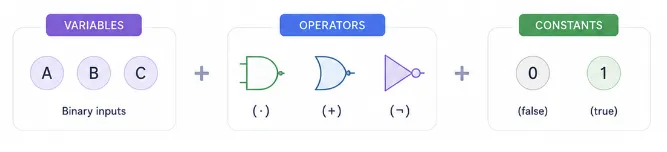
- Variables: A, B, C, etc. (binary inputs)
- Operators: AND (·) , OR (+) , NOT (¬)
- Constants: 0 (false), 1 (true)
Example Expression
Let’s look at a simple example:
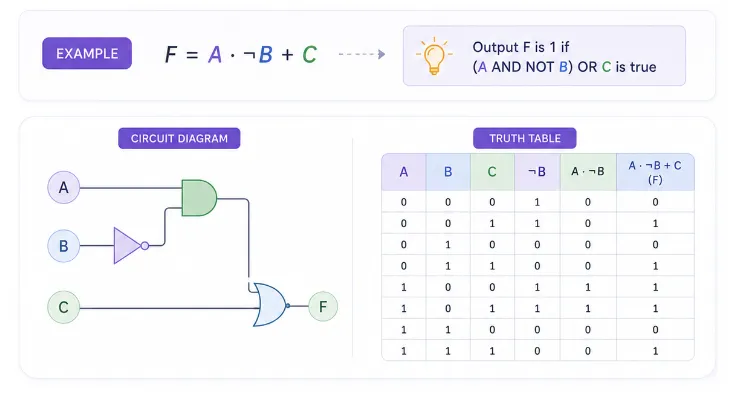
F = A·¬B + C
Its read as Output F is 1 -> if (A AND NOT B) is True OR C is True.
Standard Forms
| Form | Structure | Output Format | Example |
|---|---|---|---|
| Sum of Products (SOP) | OR of multiple AND terms | Each AND term = 1 combination of inputs | A·B + A’·B |
| Product of Sums (POS) | AND of multiple OR terms | Each OR term = 1 combination of inputs | (A + B)·(A’ + B) |
These forms are useful for translating expressions directly into gate level circuits.
Canonical Forms
Canonical forms are standardized, exhaustive representations using all input variables.
| Canonical Form | Components | Output value | Example |
|---|---|---|---|
| Minterms (Canonical SOP) | AND of all vars (true/false) | Equals 1 | A·B·C or A’·B·C |
| Maxterms (Canonical POS) | OR of all vars (true/false) | Equals 0 | (A + B + C’) or (A + B’ + C) |
In SOP Canonical, each minterm corresponds to one row in the truth table where output is 1. You can express entire functions by listing all minterms.
Example
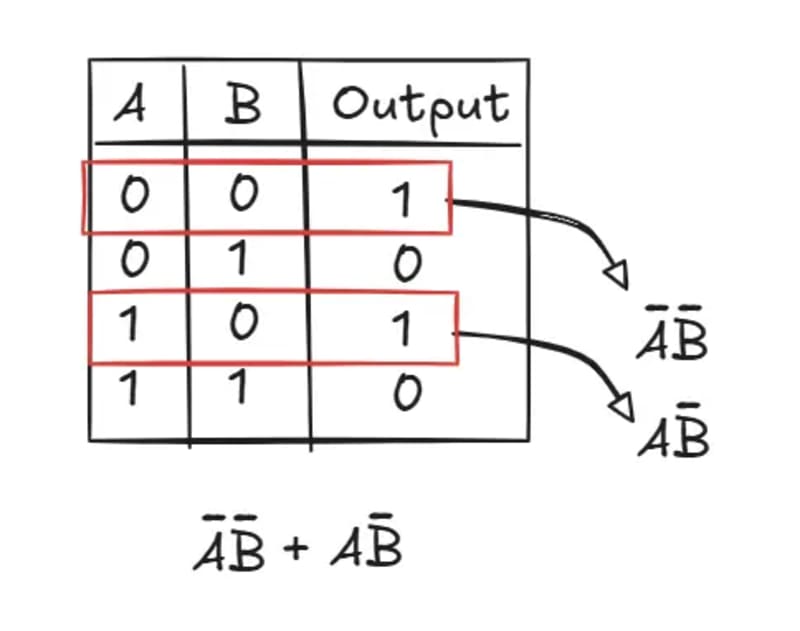
If output is 1 for rows:
Row 1 (A=0, B=0), Row 3 (A=1, B=0)
→ Canonical SOP: A’·B’ + A·B’
Simplifying Expressions
Simplification helps reduce the number of gates in a circuit. This can be done using -
1. Boolean Algebra
Use boolean algebra rules to simplify expression.
Example - F = A·B + A·¬B
On applying Boolean identity: F = A(B + ¬B)
Since B + ¬B = 1, we get F = A·1 = A
This tells us the logic only depends on A and B is irrelevant.
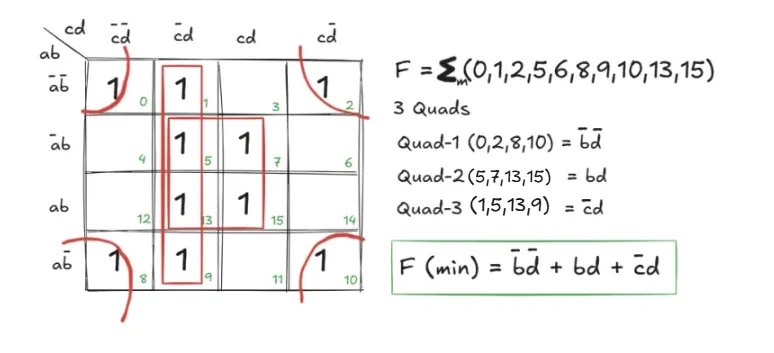
2. Karnaugh Maps (K-maps)
A K-map is a grid-based tool to simplify Boolean expressions (best for 2-4 variables).
Steps:
- Fill in 1s for where the output is true.
- Group adjacent 1s in pairs, quads or octets
- Derive a simplified term for each group (combine variables that stay constant)