Boolean Algebra
Boolean algebra is a system of logic developed to manipulate and simplify expressions made up of binary values - true or false, 1 or 0.
Started by George Boole in 1800s with a purpose to create Mathematical framework to describe logic operations. A century later it became the foundation for designing all digital circuits and computers.
Core Operations
These three operations are the building blocks of all digital logic -
- AND (·) - Outputs 1 only if both inputs are 1. Ex - Login requires password AND username
- OR (+) - Outputs 1 if at least one input is 1. Ex - Unlock a phone with Face ID OR PIN
- NOT (¬ or !) - Flips the input. Ex - If door is NOT closed, washing machine stops
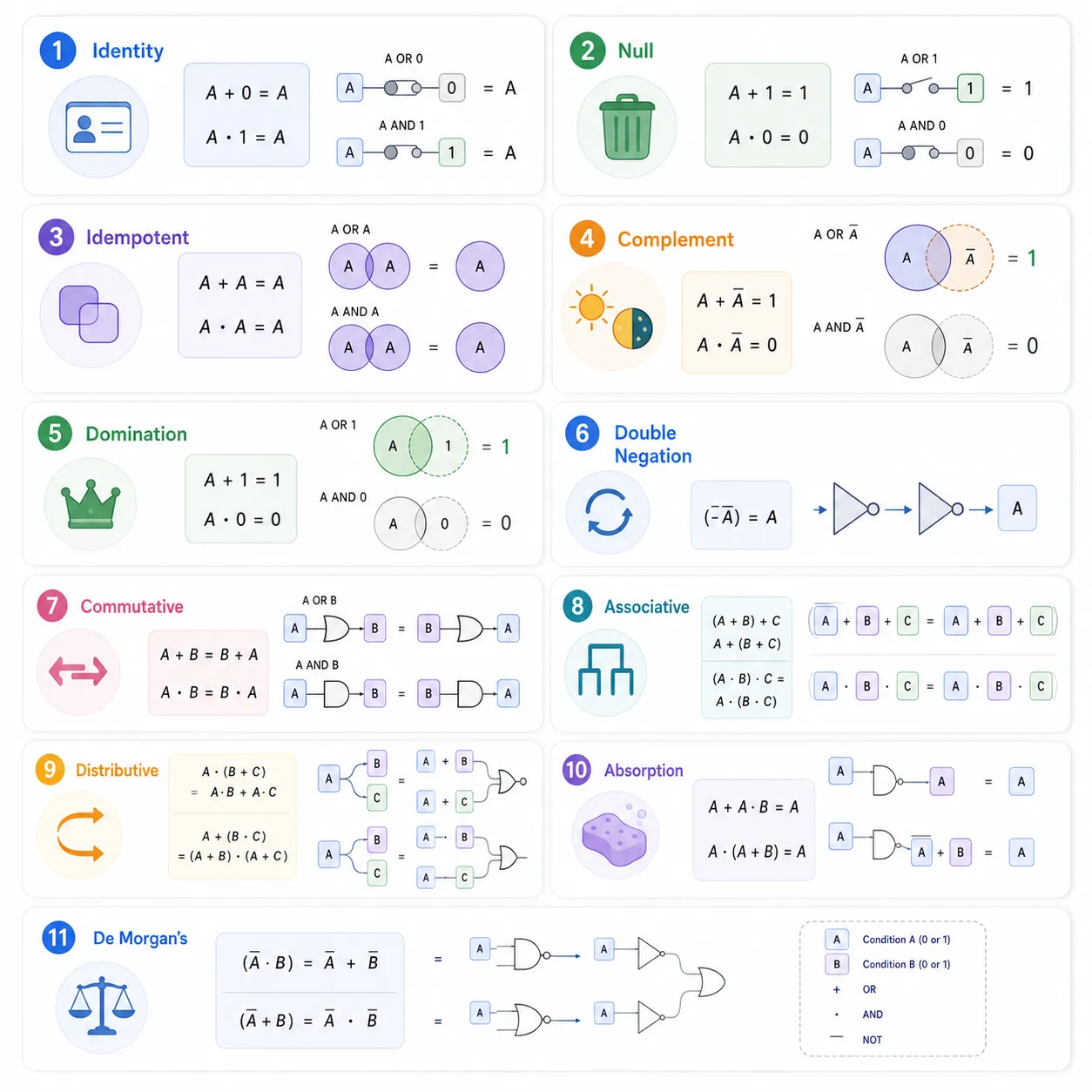
Boolean Algebra Laws
| Law Name | Expression(s) | Meaning |
|---|---|---|
| Identity | A + 0 = A A · 1 = A | Adding false or multiplying by true doesn’t change the value |
| Null | A + 1 = 1 A · 0 = 0 | OR with true always gives true; AND with false always gives false |
| Idempotent | A + A = A A · A = A | Repeating a condition has no effect |
| Complement | A + ¬A = 1 A · ¬A = 0 | A condition or its opposite is always true in OR; always false in AND |
| Domination | A + 1 = 1 A · 0 = 0 | Dominating values (1 in OR, 0 in AND) override everything |
| Double Negation | ¬(¬A) = A | Negating a value twice gives back the original value |
| Commutative | A + B = B + A A · B = B · A | Order doesn’t affect outcome for OR and AND |
| Associative | (A + B) + C = A + (B + C) (A · B) · C = A · (B · C) | Grouping doesn’t affect outcome |
| Distributive | A · (B + C) = A·B + A·C A + (B · C) = (A + B) · (A + C) | Distribute one operation over another (like multiplying over addition) |
| Absorption | A + A·B = A A · (A + B) = A | Redundant conditions can be removed |
| De Morgan’s | ¬(A · B) = ¬A + ¬B ¬(A + B) = ¬A · ¬B | Converts AND to OR (and vice versa) when negating entire expressions |
Logic Gates
Boolean operations come to life as logic gates in electronic circuits. These gates are wired together in chips to perform tasks like addition, memory storage etc., forming a backbone for digital electronics.
| Operation | Gate | Behavior |
|---|---|---|
| A · B | AND | 1 only if both A and B are 1 |
| A + B | OR | 1 if A or B is 1 |
| ¬A | NOT | Inverts A (0 → 1, 1 → 0) |

Derived Gates
- NAND: ¬(A · B) - Simply means Not-And.
- NOR: ¬(A + B) - Simply means Not-Or
- XOR: A ⊕ B - Outputs 1 if inputs differ (A or B, but not both).
- XNOR: ¬(A ⊕ B) - Outputs 1 if inputs are the same.

Summarizing Boolean Algebra and Logic Gates
Boolean algebra provides the rules of simplification, while logic gates are the physical implementation of those rules in digital circuits. Together, they form the foundation of computer architecture and digital systems.
note
Conclusion
Boolean algebra lets engineers create simple rules that machines can follow. By breaking down decisions into yes/no logic, we make systems more reliable and predictable.