Introduction to Automata Theory
The Origin of the Idea
Long before high-level programming languages existed, mathematicians tried to answer a deep question -
“Can we model human reasoning and mechanical computation with formal systems? “
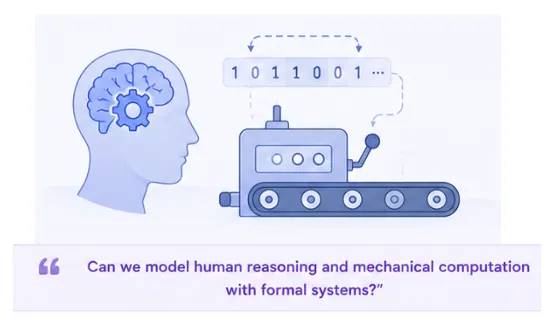
This led to the birth of automata theory, a branch of theoretical computer science that models simple machines capable of understanding structured input.
History of Automata Theory
Key figures in development of the field are
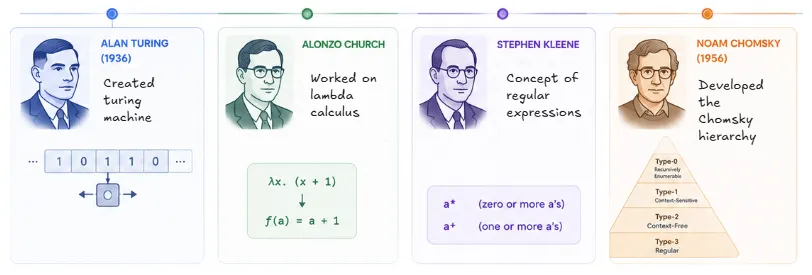
- Alan Turing (1936): Created the Turing Machine, the simplest possible machine that can simulate any algorithm. This became the formal definition of “computability”.
- Alonzo Church: Worked on lambda calculus, another formal system showing how functions and logic could be expressed.
- Stephen Kleene: Introduced the concept of regular expressions and invented Kleene star (∗) and positive closure (+) which are now core to pattern matching.
- Noam Chomsky (1956): Developed the Chomsky hierarchy, a classification of formal grammars based on their complexity.
These ideas formed the mathematical foundation of compilers, interpreters, and all modern programming languages.
The Building Blocks of Automata Theory

To model how machines understand patterns, lets first start with some basic concepts:
- Symbol: Basic building block which can be character or token. e.g- a,b,1,2 etc.
- Alphabet (Σ): A finite set of symbols. e.g- {a, b} or {0, 1}.
- String: A finite sequence of symbols from an alphabet. e.g- abb, 1010
- Language (L): A set of valid strings over an alphabet. e.g- All strings with an even number of 1s.
Operations
- Concatenation: ab means symbol a followed by b
- Union: a ∪ b means either a or b
- Kleene Closure (*): a* means zero or more a’s (ε, a, aa, aaa, …)
- Positive Closure (+): a+ means one or more a’s (a, aa, aaa, …)
These operations are what make regular expressions possible and regular expressions define the simplest class of languages that computers can recognize.
Why Does This Matter for Developers?

Every compiler or interpreter processes code through multiple stages.
The first two stages are especially important in automata theory:
-
Lexical Analysis: Breaks source code into tokens using regular expressions and finite automata.
-
Syntax Analysis (Parsing): Checks whether those tokens follow the grammar rules of the language using context-free grammars.
These stages form the foundation of compilation and language processing. Concepts from automata theory, grammars, and formal languages later extend into compiler construction, interpreters, and programming language design.